



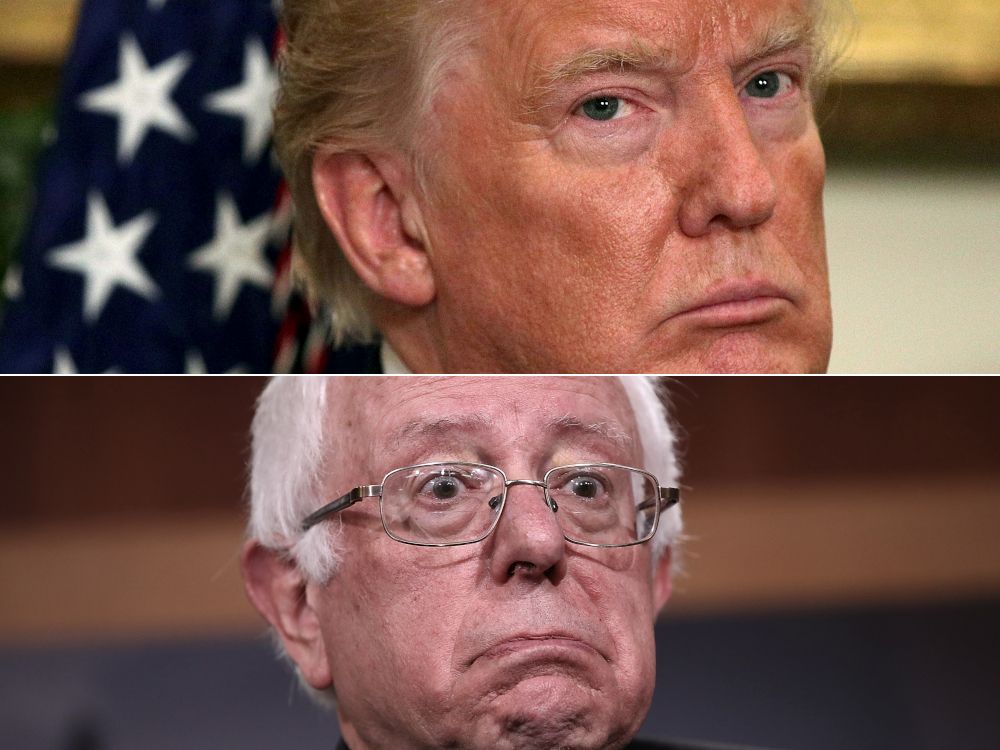
In a democracy, when all viable options on the ballot offer nothing but variations of government-directed control, there’s little choice to be had. In the United States, Democrats openly embrace the idea of a command economy directed from Washington, D.C. Likewise, U.S. President Donald Trump’s new scheme for prescription drug price controls makes clear that he also wants to push aside market mechanisms in favour of state dictates. Forget freedom, the big American political parties now offer different flavours of socialism.
On Monday, the
Trump administration complained
that, “Drug manufacturers discount their products to gain access to foreign markets and then subsidize those discounts through high prices charged in America — in essence, Americans are subsidizing drug-manufacturer profits and foreign health systems.”
This is a fair concern and one highlighted in the past by economists. They’ve proposed making it easier for Americans to buy drugs
and have them shipped to the U.S., easing the
,
with advice that would inform instead of dictate to doctors and patients, and
the Food and Drug Administration (FDA) in favour of non-governmental
.
These are good pro-freedom ideas for improving access to medicine. Some have been (partially) implemented. The FDA’s
program, for example, is an attempt to ease the laborious drug-approval process for potentially life-saving medications. The Trump administration made efforts during its
and
to make it simpler to purchase prescription medications at competitive prices.
But President Trump’s latest action reflects his taste for shaping the world
. His
addressing the high prices Americans pay for prescription drugs instructs government officials to “communicate most-favoured-nation price targets to pharmaceutical manufacturers to bring prices for American patients in line with comparably developed nations.”
The Department of Health and Human Services will establish a system for patients to purchase drugs directly from manufacturers (a mechanism that evolves naturally in free markets), with medications offered at “most-favoured-nation” prices. If the government doesn’t like the prices, the order specifies that, “The secretary shall propose a rulemaking plan to impose most-favoured-nation pricing,” and officials can take other actions to compel compliance.
There’s a lot wrong with American medicine. It mostly involves excessive regulation, government dictates and weird tax incentives. Government involvement is the problem, not the solution. Under former president Barack Obama, the government pushed health care companies to consolidate,
squeezing independent practices
out of existence because it found large companies easier to control.
In 2010, Obama administration health-care advisers Nancy-Ann DeParle, Ezekiel Emanuel and Robert Kocher boasted about the
in
published by the Annals of Internal Medicine: “The economic forces put in motion by the act are likely to lead to vertical organization of providers and accelerate physician employment by hospitals and aggregation into larger physician groups.”
Trump is embracing that same top-down approach, with medicine — in this case, the pharmaceutical industry — remaining nominally private, but subject to government command.
As the Cato Institute’s Michael Cannon, who literally
on reforming U.S. health care from a free-market perspective,
, “Trump’s executive order is an attempt to impose government price controls on pharmaceuticals.” Cannon recommended regulatory reforms to get the government out of the health-care market. “Price controls are never the answer,” he added.
A major problem with price controls is that government can dictate a price, but it can’t guarantee that anybody will produce and sell sufficient quantities of a good at that price. It also can’t eliminate the consequences of putting a ceiling on prices and lowering incentives for developing new drugs.
West Virginia University economics professor Chris Freiman elaborated on this point,
, “Drug price controls are a classic example of what is seen versus what is unseen.” What consumers will see, he noted, is cheaper drugs. But what they will never see is “the drugs we would otherwise have benefited from but aren’t created in the first place” because pharmaceutical companies fear price caps will reduce or eliminate the return on their investments.
Republicans rightly criticized then-Democratic presidential candidate Kamala Harris when she proposed combating the inflation caused by
during the Biden-Harris administration (and Trump’s first term) by
. She
to “bring down prices” by taking on “big corporations that engage in illegal price gouging and corporate landlords that unfairly raise rents on working families.” Besides rent, she had a particular fixation on
.
Even the Washington Post’s Democrat-friendly editorial board called Harris out,
, “Thankfully, this gambit by Ms. Harris has been met with almost instant skepticism, with many critics citing President Richard M. Nixon’s failed price controls from the 1970s.”
Unfortunately, Trump doesn’t just share his predecessors’ taste for price controls, he also emulates the Biden administration’s appetite for
government-directed industrial policy
, with politicians planning economic development and picking winners and losers. Trump
earlier this month about the supply choking effects of his tariff policies, saying, “A 10-year-old girl, nine-year-old girl, 15-year-old girl, doesn’t need 37 dolls.… She could be very happy with two or three or four or five.”
His comments echoed socialist Vermont senator and former Democratic presidential hopeful Bernie Sanders’
of “a choice of 23 underarm spray deodorants or of 18 different pairs of sneakers” in a free economy as unnecessary when he saw what he considered greater goals to pursue.
Interestingly, Trump’s secretary of health and human services, Robert F. Kennedy Jr.,
during the announcement of the drug price plan, “I have a couple of kids who are Democrats or big Bernie Sanders fans, and when I told them that this was going to happen, they had tears in their eyes.”
When a Republican president and his Democrat and socialist opponents agree more than they disagree about their desire for a planned economy, it’s obvious that our political choices are as severely constrained as they would make our selection of dolls and deodorants. Americans may overwhelmingly
, but our major politicians are all socialists now.
National Post

