



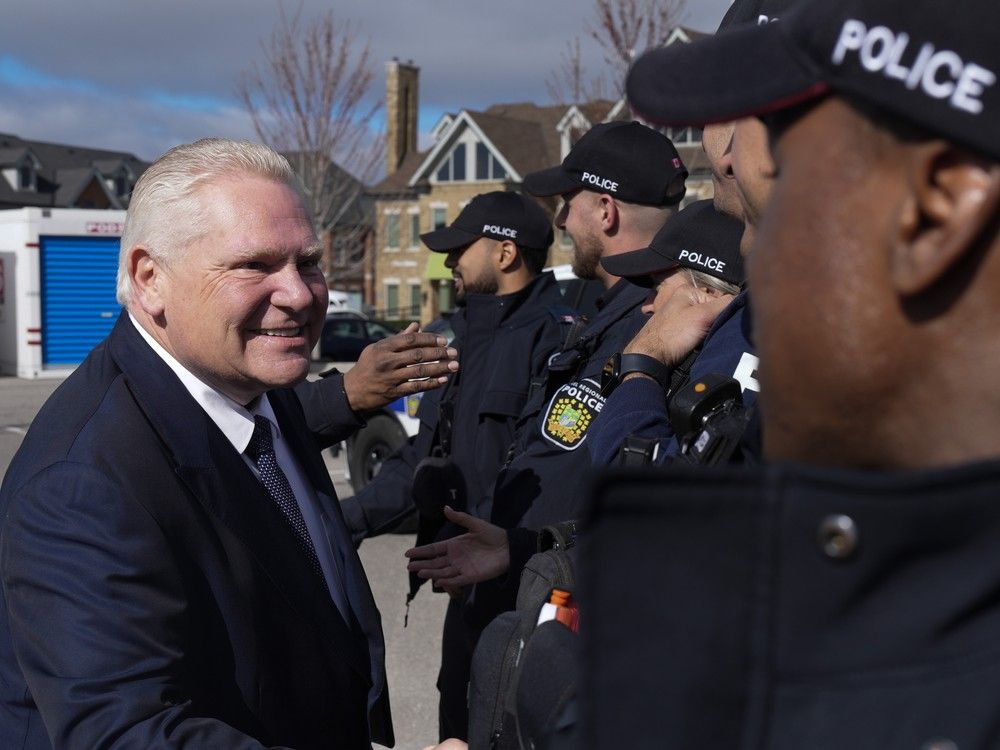
The Ontario government has announced
an array of new crime policies
that will feature prominently in next week’s provincial budget. Naturally, they are being described by the government as “tough on crime” moves.
For politicians, it’s easy to talk tough on crime, but harder to be smart on crime. The latter means running an efficient and cost-effective system to catch, prosecute and convict people guilty of criminal offences. That’s the province’s core crime responsibility.
Being smart on crime also means focusing resources on crimes that can potentially affect large numbers of people rather than those that provide the maximum outrage.
By those criteria, how does Premier Doug Ford’s approach to crime stack up? It’s a mixed bag with some good new ideas and slow progress on significant, systemic problems.
Let’s start with the good news: The Ford government is quite rightly focusing a lot of attention on cybercrime and auto theft.
The number of cybercrime incidents reported to police in Ontario
between 2019 and 2023, according to Statistics Canada. Ontario’s cybercrime rate is 196 incidents per 100,000 people. That’s slightly below the national average, but identity theft, online fraud and ransomware attacks are still far more likely to affect the average person than, say, mass murder.
One of the problems Ontario police forces face is the increasing sophistication of cybercriminals. To assist them, the government has announced a new cybercrime and cryptocurrency prosecution team that will support police investigations and prosecute major cases that result from them. Part of the focus will be on human traffickers, drug dealers and illegal firearms sellers who lurk on the dark web.
The Ford government has already taken a similar approach on auto theft, with a prosecution response team focused on hotspot cities across the province. Ontario auto theft numbers actually dropped in 2024 compared to 2023, down to 25,000 from 30,000.
That’s not the only dimension to the problem, though. The Insurance Bureau of Canada reports that auto
theft claims in Toronto alone in 2023 amounted to $372 million
, up 561 per cent since 2018. In Brampton, Vaughan, Markham, Oakville and Richmond Hill, claims are up more than 700 per cent over five years.
What’s worse, drivers across the province are being penalized whether their car was stolen or not. Insurance companies are
of between $500 and $1,500 to owners of frequently stolen vehicle models.

To deter car theft, the province has also announced a change in legislation so that police
can seize devices used to illegally open a vehicle
, but that seems more like a BB than a silver bullet.
The Ford government is also actively attacking issues in the tricky trifecta of courts, bail and jail. Problems in all three areas are inter-related and difficult to resolve.
Ontario is notorious for its court delays, a factor in a
sharply declining rate of criminal conviction
. Since 2020, a majority of charges have been withdrawn, dismissed, stayed or discharged before the accused gets to trial, according to Statistics Canada.
That makes a mockery of the legal process. The latest government anti-crime plan announces the addition of 17 new judges to help reduce this problem, along with a plan to speed up selection. Good idea. The Ford government announced 25 new judicial positions a year ago, but only eight of those jobs have been filled.
Just stop jailing criminals? The absurd odyssey of Canada’s catch-and-release justice system
The government is also keen to tackle the problem of people committing crimes while out on bail. Two years ago, it committed $112 million to stronger enforcement of bail conditions, and it has lobbied the federal government for more restrictive bail provisions, without notable success.
The
continue to support existing prosecution teams that focus on dangerous criminals seeking bail, but it drops off from there. One of the proposals is to institute a user fee for people who are ordered by courts to wear a GPS monitoring device.
The province wants to keep more people in jail awaiting trial, but it’s a costly and inefficient approach. About
80 per cent of all those in provincial custody have yet to be tried
, and Ontario’s jails are over capacity.
Ontario’s solution is to build more prisons. The province is spending $500 million on new or expanded jails. When completed, that will enable Ontario to jail even more accused people awaiting trial at a cost of $350 a day per prisoner. It would be smarter to spend the money on speeding up the courts instead.
Ford often criticizes the decisions of judges and the provisions of the federal Criminal Code, areas he does not control. It would be better to fix the problems he can attack. His government is making a good effort, but there’s a long way to go.
National Post
randalldenley1@gmail.com
Get more deep-dive National Post political coverage and analysis in your inbox with the Political Hack newsletter, where Ottawa bureau chief Stuart Thomson and political analyst Tasha
Kheiriddin
get at what’s really going on behind the scenes on Parliament Hill every Wednesday and Friday, exclusively for subscribers. Sign up here.

