


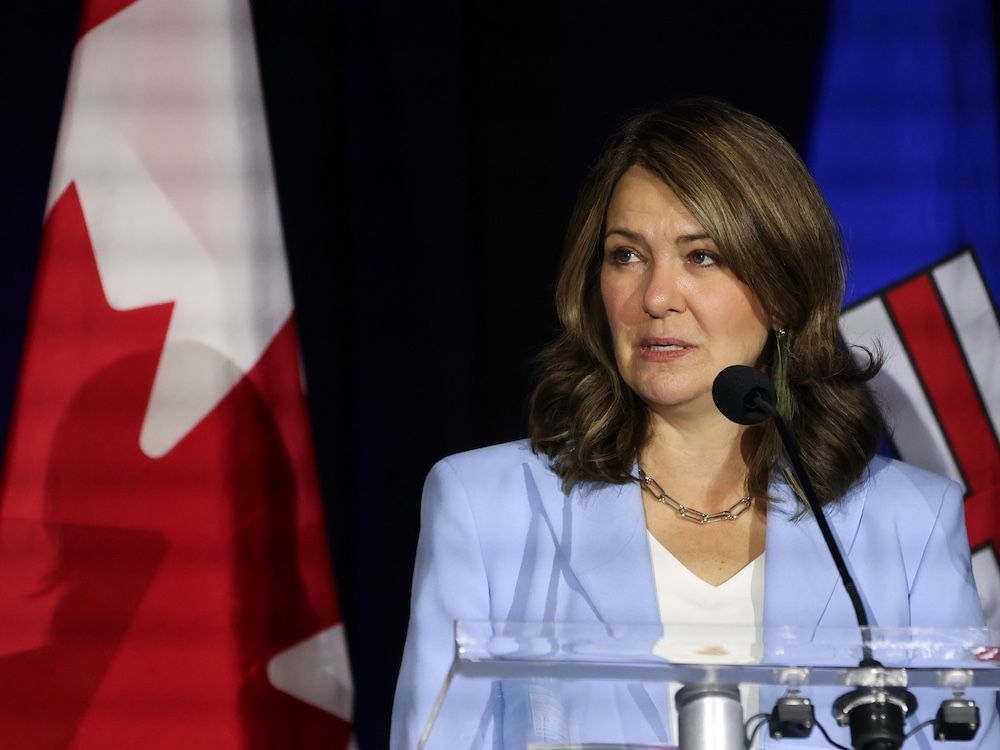
On the eve of Prime Minister Mark Carney’s critical trip to Washington to meet U.S. President Donald Trump, Alberta Premier Danielle Smith stole the spotlight and turned it firmly on herself. In a twenty-minute
she aired grievances against the federal Liberal government, from carbon taxes to Justin Trudeau’s infamous “no more pipelines bill,” C-69. Smith also presented a list of demands, from resource corridor development to greater provincial control over energy and immigration. And she pledged to hold a referendum on Alberta independence should “enough” citizens demand one — while insisting multiple times that she doesn’t support secession herself.
The timing was no accident. Smith wanted to be a topic of conversation in the White House. Perhaps she’s angling for another interview on Fox News. Or perhaps she is trying to stay in power, pacifying the same angry base that ousted her predecessor, Jason Kenney, in 2022 after he won only 51.4 per cent in a leadership review.
Whatever the reason, Smith is seizing the moment to make Alberta’s case, to the detriment of Canada’s. If Carney has trouble at home, it will be harder for him to stand strong abroad. And it’s hard to see how that helps Alberta — unless Smith has another agenda in mind. And for that, she has a model: Quebec.
Albertans often point to the success of Quebec in dominating the national conversation — and extracting concessions from Ottawa — by threatening separation. But Quebec’s grievance is cultural, not economic — rooted in preserving a French-speaking enclave in an English continent. Alberta’s complaint by contrast, is financial. The province sees itself as the country’s cash cow, milked for equalization payments and dismissed by Laurentian elites for decades — and on this, Smith is not wrong.
Alberta was
as a province in 1905, but the federal government retained Crown lands until the Natural Resources Transfer Agreement and directly controlled its resources until 1930. The province has a particularly bitter history with Liberal governments: Pierre Elliott Trudeau enacted the National Energy Policy in the 1980’s, while son Justin brought in carbon taxes, emissions caps, and the aforementioned Bill C-69 in the 2010’s.
So what could satisfy Alberta? Smith has a list: an LNG corridor, approval of new oil pipelines, and repeal or serious amendment of C-69, also known as the Impact Assessment Act. Carney has already said he would amend — but not repeal — the law, and
, he promised to cut wait times for the approval of major resource projects from five years to two. He also pledged to create trade and energy corridors for transport, energy, critical minerals and digital connectivity.
But will that be enough in the current climate? Protesters who took to the legislature
are disappointed in the election result – and don’t trust Liberals to have their back. Polls show that
of the province would vote to join the US, while
would vote for independence.
Smith may indeed be playing with fire. While Trump denies interest in a military invasion of Canada, Trump’s interest in making us the “51
st
State” is not idle conversation. He has mused about annexing the west first: could he twist history to make it Canada’s “Donbas”? Americans played a key role in Alberta’s early development: by 1916,
of its population hailed from the US, though it has been diluted by waves of immigration since then.
Carney must tread carefully — and act quickly. A referendum in 2026, as Smith threatens to hold, would weaken Canada’s position during crucial negotiations with the United States. To stave this off, Carney will have to shed some of his green mantle and expedite resource development projects that benefit the west — projects that will also benefit the rest of the country through job creation and economic activity. A fair deal for Alberta is now essential for Canada, in more ways than one.
Postmedia News
Tasha Kheiriddin is Postmedia’s national politics columnist.

