


First Reading is a Canadian politics newsletter curated by the National Post’s own Tristin Hopper. To get an early version sent directly to your inbox, sign up here.
TOP STORY
One of the many ironies of the 45th Canadian federal election is that the greatest electoral performance in the history of the modern Conservative Party was chalked up as a loss.
Conservative Leader Pierre Poilievre’s capture of 41.4 per cent of the vote has never been equalled in any of the seven prior elections contested since the party’s 2003 founding.
It’s higher than the 39.6 per cent that Stephen Harper needed to win a majority in 2011.
It’s higher than anything ever won by prime minister Justin Trudeau. His only majority win, in 2015, was delivered with just 39.5 per cent of the vote.
It’s higher than any victory by Prime Minister Jean Chrétien; across the Liberal leader’s three consecutive majority wins (in 1993, 1997 and 2000), he never managed anything higher than 41.24 per cent.
In his first-ever general election as Conservative leader, Poilievre actually scored a better result than the career high of multiple prime ministers. Lester Pearson, Paul Martin, Joe Clark; all of them won elections with vote totals that were well short of the low forties.
To find any kind of conservative party doing better at the federal level, one has to go all the way back to 1988, when Progressive Conservative Leader Brian Mulroney won his second majority with 43.02 per cent.
The problem for the Tories is that the greatest electoral performance in their history happened to coincide with the worst-ever performance by the NDP in their party’s history.
The NDP’s wholesale collapse saw the progressive vote consolidate around the Liberals unlike any time since the 1950s; ensuring that a Conservative Party at the top of its game was not only denied power, but isn’t likely to increase its caucus size by more than a dozen seats.
If Poilievre had brought a vote total of 41.4 per cent to any other federal election of the last 45 years, he would be prime minister. Prior to Mark Carney’s Monday night win, the most recent Liberal who posted a higher total was Pierre Trudeau in 1980 with 44.34 per cent.
As former Alberta premier Jason Kenney would note in an election night CBC panel, the Conservatives had also done better in Ontario than its premier, Doug Ford.
Poilievre’s Conservatives received 3.2 million votes in Ontario; one million higher than the 2.2 million ballots that Ford rode to a majority win in February.
What caused the Conservative loss more than anything is that the 45th general election effectively became a two-party race: It hasn’t been since 1958 that Canada has seen a general election in which at least 80 per cent of the popular vote has been shared among two parties.
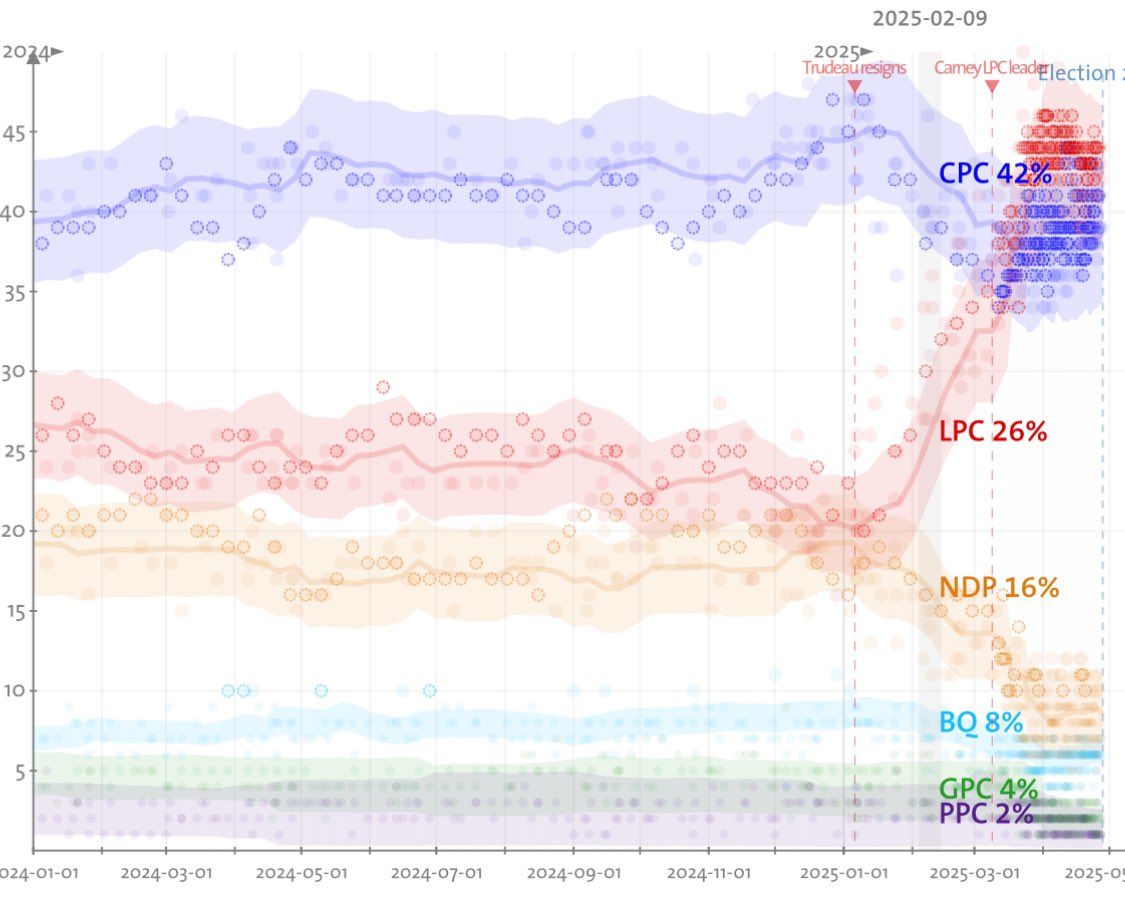
Although multiple pundits noted that the Conservatives had “lost” a 20-point polling lead that was in place as recently as December, their performance on Monday was about on par with what had been projected. It’s just that their Liberal opposition had surged by 30 points in the interim.
It was on Dec. 16 that the Angus Reid Institute published the now-famous “extinction” poll: The survey that projected the near-annihilation of the Liberal Party.
The Liberals’ total of 16 per cent was “quite possibly the lowest vote intention the Liberals have ever received in the modern era,” reported an Angus Reid analysis at the time. Projections showed that if the result carried forward to a federal election, it was likely to yield a Liberal caucus of as few as 10 MPs.
And yet, the Tory numbers in that poll were only a few points off what came in on Monday night. The Angus Reid Institute had the Conservatives poised to cruise to an untouchable supermajority with just 45 per cent.
IN OTHER NEWS
Conservative Leader Pierre Poilievre lost his own seat on Monday night; a crazy turn of events given that he’d comfortably held it since 2004. As noted by the National Post’s Stephanie Taylor and Christopher Nardi, this not only means that he won’t be able to represent the Conservative Party in the House of Commons when it reconvenes, but he’ll be getting evicted. Stornoway, the official residence of the Leader of the Official Opposition, is only available to sitting MPs.
After recapturing his seat of Bowmanville—Oshawa North on Monday night, the Conservatives’ Jamil Jivani
used a post-victory interview with CBC
to pour venom on Ontario Premier Doug Ford,
whose government didn’t just refuse to endorse the federal Conservatives, but has been accused of actively working against them
. Said Javani, “he has taken the provincial Conservative Party and turned it into something hollow, unprincipled, something that doesn’t solve problems.”
There was no First Reading on Monday as Tristin Hopper was busy hanging around the official election headquarters of NDP Leader Jagmeet Singh in Burnaby, B.C. The NDPers present weren’t as crushed by catastrophic defeat as one would assume. For one thing, they may end up holding the balance of power just the same as in 2019 and 2021.
U.S. President Donald Trump seems to be rather pleased with how everything went. In an interview with The Atlantic published Monday, he acknowledged his singular responsibility in the revival of Liberal fortunes. “You know, until I came along, remember that the Conservative was leading by 25 points,” he said. “Then I was disliked by enough of the Canadians that I’ve thrown the election into a close call, right?”
Get all of these insights and more into your inbox by signing up for the First Reading newsletter here.

