



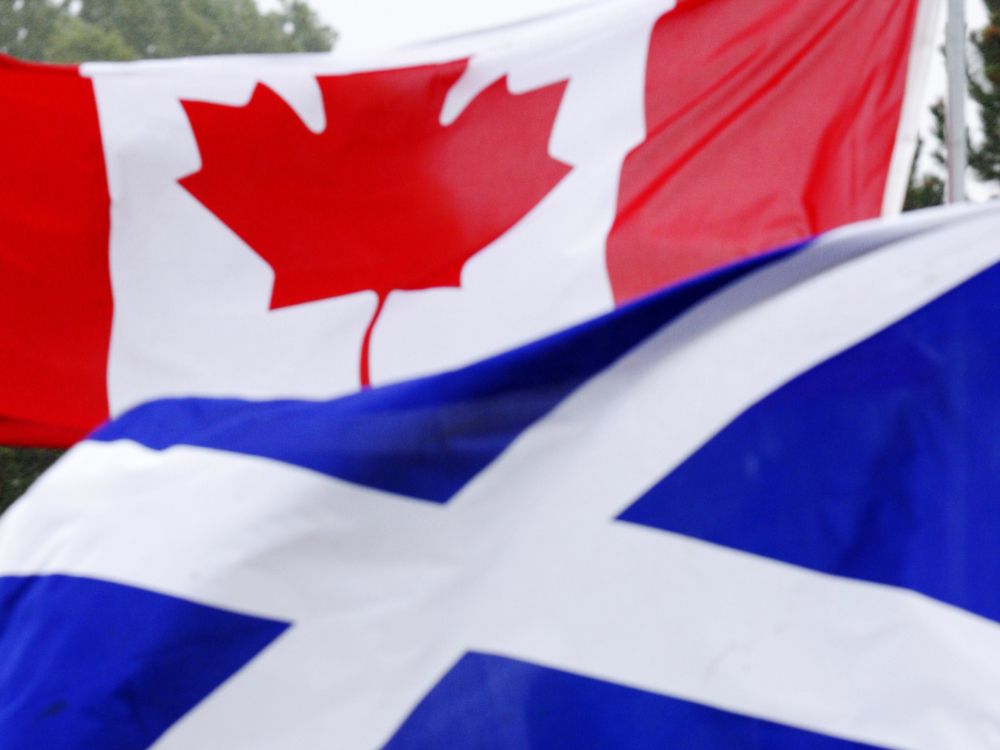
EDINBURGH — Imagine the scene that would have greeted any poor Scot who wandered off the street in Edinburgh to find himself in the middle of the annual British Association of Canadian Studies conference. Yes, there really is such a thing as the British Association of Canadian Studies (BACS) and 2025 is its 50th anniversary.
BACS is the well-worn but admirable remnants of the kind of soft power Canadian governments used to try to exercise — by getting people in other countries talking about Canada and encouraging academic links across the ocean.
The conference brings together Canadian expats living in the United Kingdom, Canadian academics who want to travel abroad and the small group of British and European academics who, for some reason or another, have decided that Canada is worth a little bit of their attention.
There’s a lot to be said for Canada’s British intellectual linkages and there were some excellent speakers here — historians, political scientists and others with some innovative thoughts on our country and, sometimes, its links to the wider world. But despite BACS’s once lofty goals, the vision of Canada it now displays is more than a little odd.
There’s nothing wrong with academic oddity. Indeed, there’s something to be said for the eccentric intellectual loftily wondering about some remnant of Canada’s literature or history. But the oddity of BACS — and pretty much all academic conferences in the humanities and social sciences these days — is its ideological skew. This is academia after all, which is dominated by the left.
If you didn’t know any better, you’d think Indigenous peoples represented half of Canada’s population and not five per cent. The intellectuals at BACS were obsessed with things like indigeneity, decolonization and reconciliation. Virtually every session had an Indigenous panel. Even sessions on literature and social policy were heavily focused on Indigenous issues.
There was also a heck of a lot about multiculturalism. But don’t assume a focus on multiculturalism somehow put Canada in a good light. The most popular theory at work in the academy today argues that multiculturalism is just a facade that hides the white supremacy at the heart of Canada. It’s just a new way to whitewash the capitalist settler colonial project that is Canada. The title of one paper was pretty succinct: “Multiculturalism as Violence.” Yes, really.
There were other topics on the agenda, and talks given by a reasonable number of distinguished academics with more moderate views. The Scots are very interested in their own independence and so have always had a soft spot for Quebec. There were sessions on Canada-U.K. relations and even one on the federal election. There were, and are, many able intellectuals talking about Canada, at home and abroad.
But the world they are living in — and the light in which they are portraying Canada — gives off a leftish-tinged fun-house mirror image of our country. In a keynote talk titled “Who Owns the Prairies,” University of Alberta historian Sarah Carter started off by saying it was all about land and people’s relationship to the land.
She celebrated Indigenous people’s spiritual connection to the land before sneering as she talked about how the settlers came and commodified it. There were the expected jokes about Elon Musk, U.S. President Donald Trump and the patriarchy.
But there didn’t seem to be any awareness of the large body of academic literature that has linked the rise of democracies in the modern era with property rights and the claim they have given citizens to demand attention from the state. It could all be summed up as “Indigenous peoples good, capitalism bad.”
One academic seriously claimed that there was on ongoing racist state project in Canada to forcibly sterilize Indigenous women. This would, of course, be horrific. She didn’t note, however, that the Indigenous fertility rate is higher than the Canadian average. So if there really is such a program, it’s not only horrifically racist, it’s also pretty inept.
In private conversations in the hallways, more moderate academics would sheepishly shake their heads at some of the more egregious claims. When one keynote speaker talked about the future of Canadian studies being activism and more activism, some did whisper that perhaps this wasn’t exactly the search for truth about their country that intellectuals ought to be engaged in. But no one openly voiced this criticism in the session itself.
In a final session on the Canadian election, the room was filled with people with an ideological diversity that ranged from socialists on the one side all the way to left-leaning Liberals on the other. Someone fretted (and expected everyone to empathize with the concern) that despite what the polls were saying, the Conservatives might win the election. God forbid!
The Trump era is exactly the time for the Canadian government to think about reinvigorating its links to the Commonwealth and other parts of the world. Canada needs to spread its wings and BACS, with all its eccentricity, could be part of that.
But before this could happen, Canadian universities need to deal with their zany radical leftist problem, and create a culture that calls out the truly bizarre and outrageous claims being made by activists posing as scholars. They would never let radical right-leaning scholars get away with making the same kinds of claims.
We need to put on a better show for the world — even to the random Scot in Edinburgh who shows up to learn about this bizarre things called “Canadian studies.”
National Post