



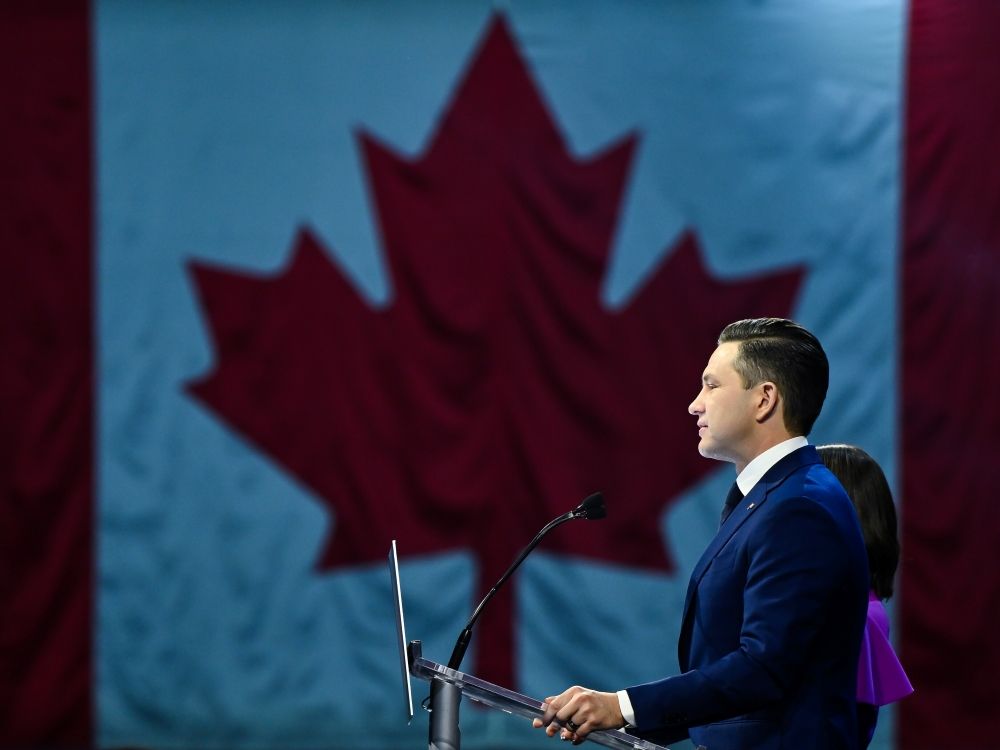
The Conservatives couldn’t control the one big thing that went wrong for them in the campaign, but they could control the mounting pile of little things. With an election so close — the Liberals winning 168 seats, the Conservatives, 144, as of 10 a.m. ET Tuesday — those little things amounted to a fatal speed bump. Even Conservative Leader Pierre Poilievre didn’t survive, politically speaking, in his riding, having
his seat by about 3,800 votes.
The one big thing, of course, was Donald Trump, who the United States elected as president back in November, and who, by January, took to waging trade wars — first on Canada, then the world — and talking with increasing seriousness about making this country a 51st state. The deadweight leader attached to the Liberals cut himself free and lined up a technocratic replacement who didn’t repulse the country with every breathy sentence he spoke. Canada’s Conservatives, despite commanding a soaring lead since the summer of 2023, plummeted in the polls.
This phenomenon isn’t unique to Canada: in Australia, the opposition Liberal-National Coalition (the analogue to our Conservatives) was the favourite to win an election since the fall of 2024, their poll performance
in late December. From there, their ratings tumbled, and now they’re projected to lose the May 3 Australian federal election. The Trump effect is a real, brutal thing.
But unlike in Australia, Canada’s Conservatives held the lead since Poilievre became leader in the fall of 2022 — narrow, at first, but by two years later, that gap
nearly 20 points.
The initial collapse of their lead in the polls hurt, but at least it wasn’t the Tories’ own fault. Then came the self-inflicted wounds.
There was the slow pivot: in the weeks that Trump made daily annexation thrusts at Canada, the party stuck to its “axe the tax” messaging, treating the new hostility of the United States as a secondary concern. Canadians — boomers, in particular — wanted a protector more than they wanted a tax-axer, and Poilievre was slow to deliver.
Poilievre ultimately put anti-Trump resistance front and centre in his overarching pitch for economic resilience. But by that point, impressions had been made.
Which brings us to the next little hiccup: the media. The Conservatives diagnosed that mainstream Canadian broadcasters and newspapers typically have a systemic Liberal bent, and they were right; many journalists have leftward personal convictions, and many others outright believe that social justice — that is, the advancement of progressive politics — should be the core goal of their work.
As for what to do about it, Poilievre’s team limited the access of traditional journalists and engaged more with content creators native to YouTube and other parts of the internet. At most of his press conferences, he took only four questions, and his team pre-selected who would have the privilege of asking. His answers, though clear, could become cloudy with slogans that cast a formulaic shadow over his human side.
To his credit, Poilievre did show a warmer, relatable side in numerous podcast appearances, but these didn’t achieve a Trump-on-Joe-Rogan-Experience scale of reach.
Then there was the platform and, broadly, communications. The Conservative platform was decent on many fronts, but it still felt incomplete for a document that should have been three years in the making: the revenue assumptions
overly optimistic and
based on number games. To add, it was poorly designed, with no white space, questionable photo placement, condensed spacing and lists unnecessarily broken by pages, while campaign communications had a tendency to YELL at any readers with overabundant capitals. Aesthetics and, yes, vibes, matter.
Finally — and a lot of this wasn’t Poilievre’s fault, but Conservatives elsewhere — was the party drama. Doug Ford’s staffers trash-talked the federal campaign, questioned its strategy and even seeded stories of doubt in progressive media. Nova Scotia’s Tim Houston launched an interestingly timed get-to-know-me video filled with Carneyesque nostalgia nationalism. The
between Poilievre’s team and Houston’s team resurfaced. It didn’t help that Albertan separatists started to rev their engines. Egos flared, and the outward infighting signalled instability when the public was looking for the opposite.
Poilievre did his best to send a message of unification and hope — even, after congratulating Carney on the win,
boos made in response to the Liberal leader’s name.
Political parties all have internal spats. What’s essential now is that the Conservatives remember all that they got right. They set the parameters of political debate in Canada for the past two years, reversed the nation’s support for the carbon tax and appealed to the youth without becoming Liberal-lite, defended its stances on crime with principle. They had the makings of forming a mega-majority up until a few months ago.
And they very well may have that again, once Carney’s honeymoon phase reaches its end. They can try to fix the minor errors, or at least hope that no new political black swan events make the little things fatal again.
“We will continue to put forward the best arguments to improve the lives of our people right across this country,” Poilievre told the crowd in his concession speech, and that’s exactly what needs to be done now, even without an MP as leader. The movement has hope, as long as it holds together and keeps the feuds at bay.
National Post

