



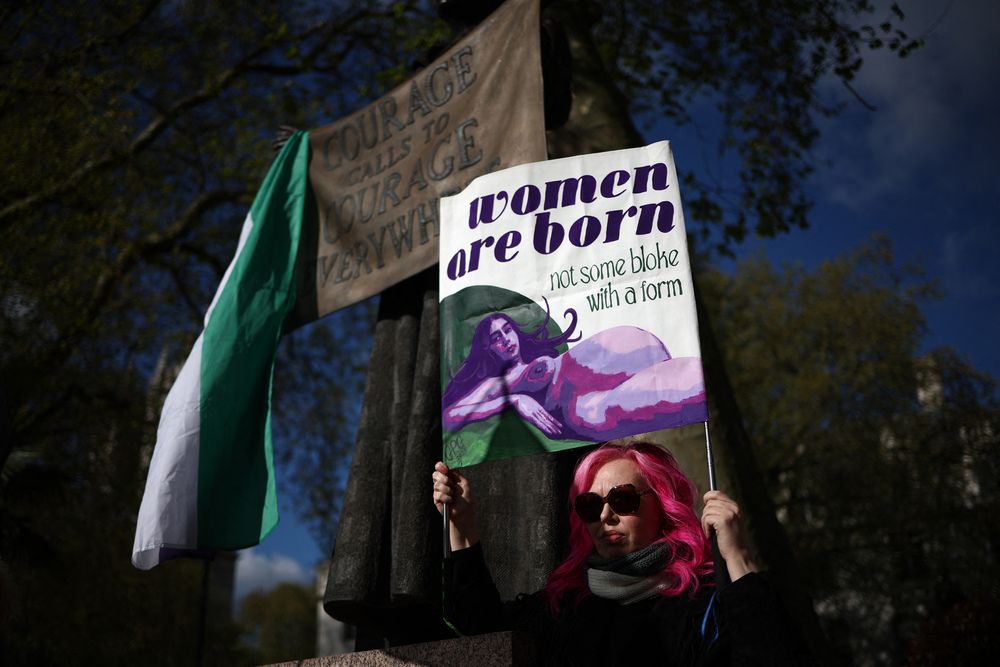
Within a week of the U.K. Supreme Court issuing a landmark
confirming that women are female, the Conservative Party of Canada has taken a small, but long-overdue, step in the same direction. The newly released CPC
announced it would repeal a federal policy that allows trans-identified men to be housed in women’s prisons and committed to ensuring that “women’s spaces and services remain protected in federal institutions and policy.”
After years of official political platform silence on the erosion of women’s sex-based rights in Canada, this marks the first major promise by any federal political party to confront the legal consequences of gender ideology head-on. The Canadian legal system may also soon be forced to wrestle with the matter.
Across the Atlantic on April 16, the U.K.’s highest court delivered clarity that remains sorely lacking in Canada. Five justices
that under the U.K. Equality Act, the term “woman” refers specifically to biological females, and “sex” denotes biological sex.
The ruling further clarified that when it comes to women-only spaces or services, men who identify as women — even those in possession of a gender recognition certificate denoting a female gender identity — do not have a legal right to access those spaces. The judges maintained this was the only interpretation that could be consistent and coherent within the law.
Such consistency and coherence have been absent from Canadian law ever since gender identity was embedded in the nation’s legal framework. This happened through a gradual process that began with the
in 2002 and culminated in the federal Parliament’s passage of Bill C-16 in 2017, amending the Canadian Human Rights Act and Criminal Code to include
gender identity and gender expression
as prohibited grounds of discrimination.
Protecting gender identity alongside sex isn’t just contradictory — it’s logically impossible. Ontario’s Human Rights Code perfectly
this doublethink. It permits sex-based segregation in spaces like bathrooms and change rooms to preserve “human dignity,” yet the Ontario Human Rights Commission’s
of the Code states that trans-identified people “should be provided access to facilities that are consistent with their lived gender identity.” This means men who identify as women are permitted into female-only spaces, rendering those spaces no longer female-only, while all concern for the safety and dignity of women is tossed aside in the process
Canadian women and girls find themselves at a distinct disadvantage to their
given that, unlike the U.K. Equality Act, our human rights laws contain no clear language allowing for female-only spaces. Instead, Canada
on vague balancing tests and case-by-case rulings. Female-only spaces can exist, but they must be justified as necessary.
It should be self-evident that sex matters in contexts where safety, dignity, and vulnerability are at stake.
(and elsewhere) commit most sexual offences, and females comprise nearly all the victims. That fact alone ought to justify single-sex spaces. But in Canada, evidence still takes a back seat to ideology.
Nowhere is this reckless capitulation to gender ideology more starkly felt than in Canada’s female prisons. After the passing of Bill C-16, the Correctional Service of Canada adopted Commissioner’s Directive 100, which allows male offenders to be placed in women’s prisons based solely on self-declared gender identity, “
regardless of their sex (i.e., anatomy)
.” It is this policy that Pierre Poilievre’s Conservatives have pledged to repeal if elected on April 28th.
Poilievre’s announcement comes just days after the launch of a
by the feminist organization Canadian Women’s Sex-based Rights (CAWSBAR). Their legal challenge
that women have the right “to be protected from mental, physical and sexual abuse by Trans-identifying Male Inmates with whom they are forcibly confined,” and “pleads that such forced confinement has caused, and will continue to cause, serious harm to Female Inmates.”
CAWSBAR’s case claims that forcing vulnerable female inmates — many of whom are victims of male sexual violence — to be housed with trans-identified males is “cruel and unusual punishment,” and “undermines their rehabilitative efforts.” It also notes that trans-identified male inmates are “significantly more likely to have been convicted of a sexual offence” compared to the general male prison population.
The reality is that an “F” on a man’s driver’s licence or birth certificate is a legal fiction: a symbolic gesture that does nothing to alter the biological reality of his male body. It doesn’t change his anatomy, his physiology, or the statistical risk he poses. No reclassification on paper can erase the well-documented disparity in violent and sexual offending between males and females. Yet, policymakers in Canada continue to act as though this fiction carries the weight of reality.
It’s time Canada grappled with some difficult questions. Should Canadian society be compelled to structure itself around a legal fiction? And should women and girls be expected to shoulder the very real risks of male intrusion into their spaces in order to uphold that fiction? The U.K. Supreme Court has drawn a clear line in defence of women and girls. It remains to be seen whether Canada’s judiciary will have the courage to do the same.
Mia Hughes specializes in researching pediatric gender medicine, psychiatric epidemics, social contagion and the intersection of trans rights and women’s rights. She is the author of “The WPATH Files” and a senior fellow at the Macdonald-Laurier Institute.
National Post

