



First Reading is a Canadian politics newsletter that throughout the 2025 election will be a daily digest of campaign goings-on, all curated by the National Post’s own Tristin Hopper. To get an early version sent directly to your inbox, sign up here.
TOP STORY
For the second time in the 2025 election, the Liberals have received the endorsement of a high-profile expat who hasn’t lived full-time in the country for several decades.
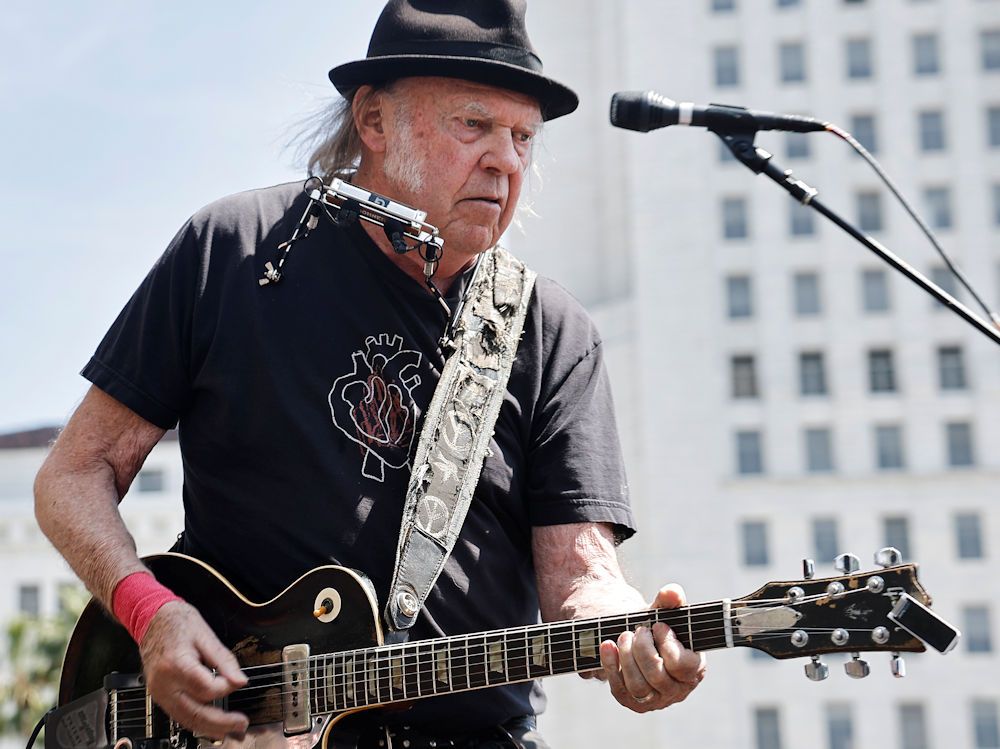
On Monday, Winnipeg-raised rock icon Neil Young published an open letter on his official website entitled “I’m With You, Mr. Carney.”
“I am writing because I want to tell you how much I appreciate and support what you are trying to do for our great country, Canada,” he wrote, before outlining his outrage at U.S. moves against Canada, and his support for Carney in opposing them.
“I believe you are the person our country needs to lead us through this crazy situation and bring us out the other side as a stronger, smarter, more resilient Canada,” he wrote.
Although Young did not mention the ongoing election or specify whether he intended to vote in it, he ended by declaring he was “with you all the way.”
This follows upon a pair of videos produced early in the campaign between Carney and Mike Myers, the Canadian-born actor most famous for the Austin Powers franchise.
On a set made to resemble the sidelines of an ice rink, Carney quizzes Myers on various items of Canadiana, such as the name of the two puppets on the long-running CBC children’s series Mr. Dressup.
“You really are Canadian,” says Carney upon receiving the correct answers.
Both Myers and Young live primarily in the United States, have obtained U.S. citizenship, and are even on record expressing their pride at having become Americans. Myers last lived full-time in Canada in 1986, Young in the mid-1960s.
In a 2022 interview, Myers spoke of his gratitude at becoming a U.S. citizen, praising the “strong ideals” of the United States. “I don’t take it lightly at all; it’s a very, very important thing to me,” he said.
Young became a U.S. citizen in 2020, which he celebrated by declaring his intention to vote against U.S. President Donald Trump. He also recorded a short song declaring himself a “Cana-erican.”
Just this week, Young’s wife Daryl Hannah accused the Trump administration of having attempted to sabotage the process.
“They tried every trick in the book to mess him up, and made him keep coming back to be re-interviewed and re-interviewed. It’s ridiculous (because he had) been living in America and paying taxes here since he was in his 20s,” she told the BBC, according to comments published in the San Francisco Chronicle.
Young does own a cottage outside Omemee, Ont., the “town in North Ontario” mentioned in his hit 1970 song Helpless.
At the height of COVID lockdowns, Young lived there for six months with Hannah, but is otherwise known to divide his time between Colorado and California.
Just last week, he was pictured in Thousand Oaks, Calif., attending an anti-Trump street protest, where he held a sign reading “hands off Canada.”
Given the specifics of Canadian tax law, it’s unlikely that either has paid significant Canadian income taxes at any point since obtaining stardom.
Canadian citizens become exempt from federal income taxes the moment they become a “non-resident” by moving abroad. As such, both Myers and Young would only owe taxes on a “Canadian source income.”
This is distinct from the United States, which taxes its citizens regardless of residency. Any U.S. citizen living as an expatriate in Canada risks losing their U.S. passport if they don’t make annual filings to the Internal Revenue Service.
Celebrity endorsements are a rare feature of Canadian elections for the precise reason that a disproportionate number of Canadian celebrities live in the United States as expats.
Actor Jim Carrey has been active in U.S. politics, and endorsed Democratic candidate Joe Biden in the 2020 presidential election. But he’s been mum on the 12 Canadian general elections that have occurred since he moved to the United States in 1983.
In the 2019 general election, actor Ryan Reynolds issued only a vague social media post that didn’t mention any specific candidate or party, but reminded Canadian voters that they would be picking a government that would “SHAPE CLIMATE POLICY.”
TORY VS. TORY
One of the less appreciated aspects of power politics in Canada is the issue of candidate nominations. While some candidates obtain their positions via open nominations, a good chunk of them are still parachuted into ridings based on orders from party HQ. One of the effects of this is to consolidate power around the party leader, since he ends up being surrounded by a caucus of people who owe their nominations to him personally, rather than their riding association (a dynamic that was painfully obvious during the drawn-out process to remove Justin Trudeau).
The messiest iteration of this was in Abbotsford–South Langley, where the local pick — former B.C. finance minister Mike de Jong — was pushed out in favour of a 25-year-old rookie. De Jong is now running as an independent, and he’s been endorsed by Ed Fast, the riding’s longstanding Conservative MP.
THE DEBATES
The French-language debate
,
and the Green Party didn’t end up being invited. The Leaders’ Debate Commission had initially scheduled the party to appear, before realizing that the Greens didn’t actually meet the requirements. If they’d been polling higher than four per cent, or were running candidates in at least 308 ridings, they would have been allowed on stage, but they managed neither.
Get all of these insights and more into your inbox by signing up for the First Reading newsletter here.

