



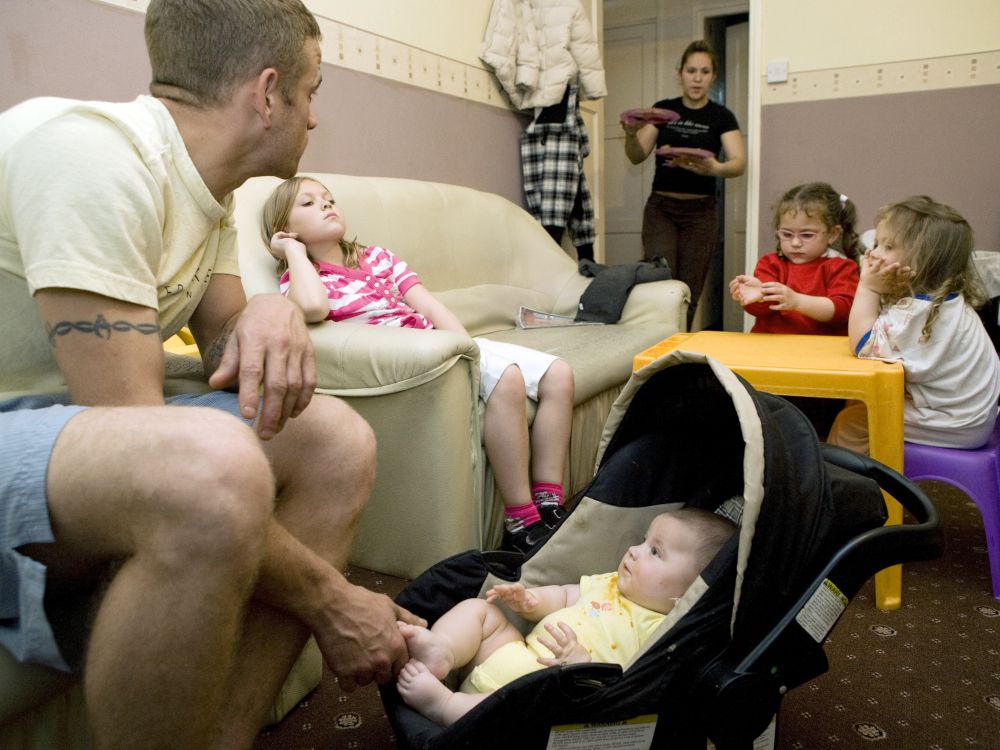
Michelle Sabari always wanted to have six children. She started dating her husband in university and told him her plan — and he was game. By age 30, they were both finally done with school, had jobs and felt stable enough to start a family. Three kids came in four years, and they took a pause to regain their footing. But she didn’t feel “done” — not even close.
“It’s just so beautiful having a big family and everyone helping each other. I love it, and it’s not just babies,” she says. “Yes, I love babies. Yes, I love breastfeeding. Yes, I love being pregnant. Even my teenage daughter is fun. Everything is a challenge to me and each step is so beautiful.”
Now in her mid-40s, she has her six kids — and would love to have one more. But she’s worried about her age, plus she’d have to upgrade from a minivan to a minibus.
Sabari is an outlier, however. Canada’s birth rate dropped to a historic low of 1.26 children per woman in 2023, according to
, and we joined an exclusive club of ultra-low fertility countries like South Korea, Spain, Italy and Japan.
Canada has vastly increased immigration in recent years, which should delay the consequences of a declining native-born population. Still, the government is concerned.
Canada, like most of the developed world, spends tens of billions a year on pro-natalist policies to try and increase the birth rate, because it knows the economy is likely to suffer as people age and there aren’t enough workers to shoulder an increasing tax burden.
Parents can receive a
of up to $8,000 per child, hundreds of dollars a month in the form of the
,
if they can get a spot,
and some provinces, like Ontario, even offer free daily
for babies and toddlers with high-quality toys and programming. But all of it has failed — the birth rate just keeps declining.
So is there anything the government can do to incentivize Canadian men and women to have more kids? To answer this question, I decided to talk to women like Sabari who are bucking the trend and having large families.
It’s easy to list the reasons why Canadians aren’t having more children — reliable contraception, high housing prices, women prioritizing careers, late marriage and a culture that values the individual over the family. So why is it that some women are still choosing to have multiple children? Have Canadian pro-natalist policies influenced their decisions? (spoiler: no). And can we learn anything from these women to help increase the birth rate of our society as a whole?
I was inspired by Catherine Pakaluk, a political economist and associate professor at the Catholic University of America. Herself a mother of eight, she travelled around the United States interviewing college-educated women who had five or more children and wrote up her research results in the book, “Hannah’s Children: The Women Quietly Defying the Birth Dearth.”
I spoke to her earlier this year about Canada’s generous pro-natalist policies and she posits that they don’t work because while they are nice to have, having an additional kid is such a big investment that the state would never be able to afford what it would take to really encourage someone to have more kids.
“Some people have tried to figure out what would be enough to make a difference, and most people argue that that would be in the range of half a million dollars per child,” Pakaluk says. “If you could somehow subsidize families for a next child to that magnitude, of several hundred thousands, you may fundamentally change people’s view of having the next child.… I think that’s probably where we would be if we wanted to persuade people.”
In other words, pro-natalist policies are simply a little reward for people who already want kids, but aren’t going to convince anyone to add an additional child.
Sabari agrees that a long maternity leave and the child benefit didn’t influence her decision to have a large family. “All it’s doing is helping those who have kids slightly,” she says. “Yay, I have a little extra money for my children. But it wouldn’t be an incentive to have kids, it’s just a little padding once I have a child.… If you gave me money and said, ‘Here’s all the money to raise a child until 21,’ I would have another kid, maybe.”
Child rearing is simply too intensive for government support to make a meaningful difference — and any support that would make a meaningful difference would bankrupt the state. What actually appears to encourage women to have more children is not more money, or more time off work or cheaper houses, but religious affiliation.
Religious women don’t all have large families, but of those who do have large families, many are religious. Indeed, all of the mothers Pakaluk found to interview in her book were religious, whether Catholic, Jewish or Mormon.
A 2023 survey of 2,700 Canadian women conducted by Cardus, a Christian think-tank, found that those who attend religious services at least once a month tend to spend more of their life married and have more children than other Canadian women. At the same time, these women were also employed at similar rates as non-religious women. American studies have found similar results.
Why religion seems to influence family size needs more research. Is it simply that religious women have larger communities and therefore more support as moms? Is it a mandate from the religion they follow, like the Abrahamic religious dictate to “be fruitful and multiply”? Is it the cultural values within religion that prioritize marriage and family? Or is it that religion promotes trust and faith in the future?
Mushka Bernstein is an Orthodox Jewish woman and youth programming director for a synagogue in Vaughan, a city just north of Toronto. She has three little ones, after she and her husband decided to leave the family planning up to God.
Since she is only 24, her family could potentially grow into the double digits, like her mother-in-law, who has 11. (Bernstein is the eldest of nine.) Unlike most young secular Canadian women I know, she thinks of children as blessings and believes that God will provide the money and stamina necessary to raise each child.
“A lot of parents, when they’re thinking about having another kid, they’re thinking of the childbearing years, like newborn stage and taking their kids to daycare and things like that,” she says. “What we really want to try to think about as Jews is also the future generations.
“This child is going to grow up to continue the Jewish people and the more children we have, the more good there is in the world and the more good deeds there are in the world. So we can’t just think about ‘yeah it’s hard.’ No one is saying that it’s easy, but we look at the greater picture, we look at the greater good and what’s going to happen later on, too.”
That kind of worldview — that each child will contribute to a positive future and your personal decision to have children has an impact on your community as a whole — has almost completely disappeared from Canadian culture.
Instead, when my secular friends are deciding whether to add a second or third child, they frame their decisions as being about how much of a burden they can handle. Each child, while bringing a measure of joy, is also thought of as a potential drain on their finances and time. They list anxiety and fears about the future of the world, such as climate change and wars, as reasons not to procreate.
In sharp contrast, women like Bernstien and Sabari have a sort of trust that they can handle any additional child, and also an optimism for the future. “I wouldn’t really say ‘God will provide,’ per se, but more so, ‘We’ll figure it out, it will get done and we’ll find a way,’ ” says Sabari, who attends religious services weekly.
“Yes, you shouldn’t have children if you walk around with the mentality that the world is about to end. Then of course you don’t want to bring a being into the world. If that’s your mentality, then don’t do that, 100 per cent. I think this has to do with my mindset that children are the next generation. They’re going to bring us something new and new ways of doing things. They’re going to have new ideas.”
Religion seems to provide a sort of buttress against the nihilism and anxiety that’s so prevalent in millennials and gen Z, which prevents them from taking the leap and having more than one or two kids.
Of course, the answer is not to make religion more prevalent in our society. That would likely not even be possible, or desirable. But instead of just throwing money at the issue, which hasn’t worked anywhere it’s been tried, we should look more closely at communities that are having children to figure out what they’re doing right that could translate to a wider population.
At the same time, we must examine the cultural barriers in our own society that stop parents from feeling like they can successfully handle the challenges that come from a house full of children.
National Post

