



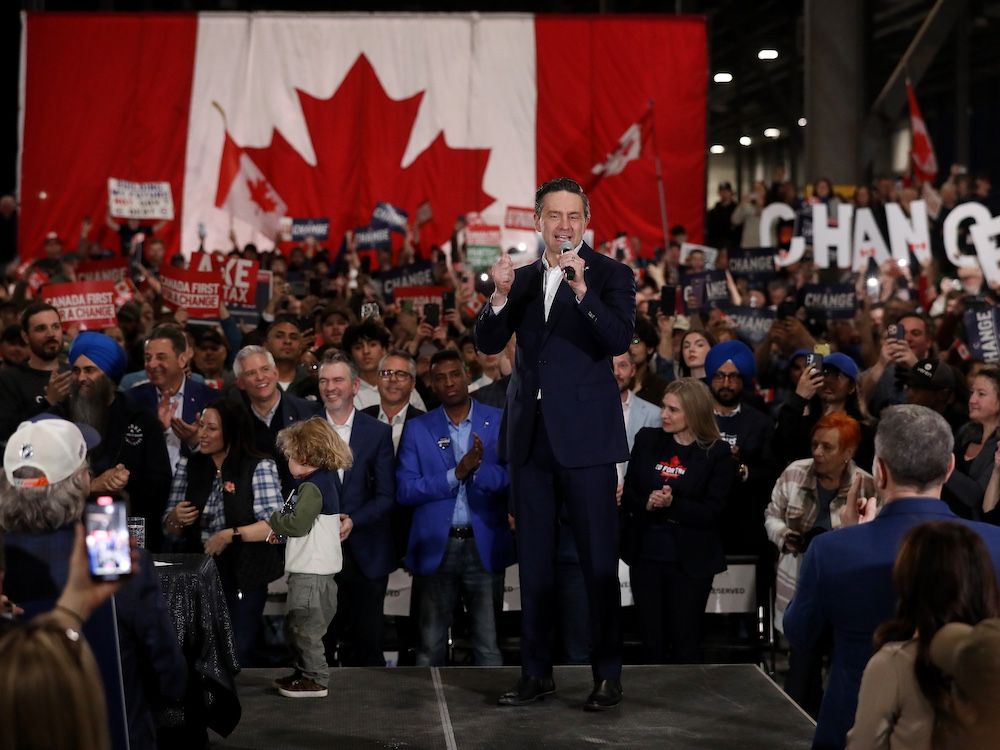
Having started with a rally larger than anything seen in recent Canadian history, and ending on yet another policy fail by Liberal Leader Mark Carney, this past week marked a turning point in the Conservative campaign.
Conservative Leader Pierre Poilievre has honed a message of strength when it comes to managing Canada’s relationship with the United States, tying the issue to affordability and quality of life with the common denominator of self-sufficiency.
Meanwhile, the election has shifted away from the U.S., now that President Donald Trump has dialled back his wrath for Canada and spread it to the rest of the world. There’s been little talk lately of a 51st state and its “governor.”
The conversation has thus turned back to Canadians’ homes becoming less affordable and their cities becoming less safe over the last 10 years.
It’s true that the Liberals are
in the polls, and a somewhat
gap hasn’t changed the trajectory. But a trickle of underwhelming Liberal proposals and a breeze of current events favour the Conservatives with about two weeks left in the campaign.
On the ground, this has translated to a dedicated, large, organic following for the Conservative leader. Poilievre has been attracting crowds of vast sizes across the country:
in Fredericton (pop. 63,000);
in Kingston, Ont. (pop. 140,000); 6,500 in Oshawa, Ont. (pop. 190,000);
in Sault Ste. Marie, Ont., (pop. 72,000);
in Winnipeg (pop. 750,000).
Largest of all was his Monday night rally in the small town of Nisku, Alta., on the outskirts of Edmonton, which hosted between
and
people — so many, it had to be moved to a bigger venue at the last minute.
Carney, on that same evening, attracted only
to a Richmond, B.C. (pop. 223,000) event. Then, in Calgary on Tuesday, he drew
supporters in a city of 1.4 million. The next day,
came out in Saskatoon (pop. 290,000), followed by
in Hamilton, Ont. (pop. 600,000). He’s lacked Poilievre’s magnetism, and has instead drawn smaller, older crowds that are more
.
At the same time, the ink in Carney’s policy pen seems to be running out, as he’s been copying the gist of Poilievre’s ideas and filling in the details with what are often proven Liberal failures.
Last month, Poilievre
to harmonize provincial rules to allow tradespeople to work everywhere in the country and to increase apprenticeship grants. Carney followed that up last weekend with a similar promise to work towards ending trade barriers by
for trades training up to $8,000 (the key term being “up to”).
Carney also says he’ll keep the
of “up to $10,000” for employers of newly hired apprentices. These grants encourage employers to discriminate on the basis of identity by paying only $5,000 to hire apprentices who don’t check any diversity boxes, while doubling the payment to $10,000 for racial minorities and new immigrants, among others.
Carney’s proposed training grants could very well come with the same identity-based strings attached. All he has are more Trudeau-style programs, when all that most people really want are back-to-basics solutions that get more young people into steady, reliable jobs.
Similarly, Carney finally elaborated on his solutions to the housing crisis,
to spend nearly as much on prefabricated homes as the Liberal government has spent on battery plants (which are
to result in a net loss to taxpayers, by the way), a project proposal that will fail if the Liberal
on building anything is any indication.
What’s needed are not more incentives for under-performing contractors to bloat their budgets, as the Liberals propose, but the liberation of builders from the mountain of project-killing taxes, charges and procedural gunk that stand in the way of building new homes.
Poilievre’s straightforward
is to cut sales taxes on new homes and to incentivize municipalities to cut development charges — immediately opening the taps on supply.
On energy, Carney is primarily echoing the skeleton of Poilievre’s plan with sub-par ideas grafted on. Poilievre’s concept of an
for example, has been
by Carney; both are promising shorter project review timelines (Poilievre’s being
Carney, two).
But Carney is planning to keep the same old review process in place and funnelling even more cash to Liberal-approved climate projects, while Poilievre would make serious reforms by
the Impact Assessment Act entirely.
Meanwhile, on crime, Carney has shown himself to be desperate for ideas: after
for weeks, he is now struggling to make the case for a safer Canada as Poilievre puts forward plans for
minimum sentences for violent criminals, human traffickers and
, along with tighter bail rules.
In response, on Thursday, Carney vaguely
that he’ll tighten bail laws for a narrow selection of crimes (with no explanation as to how), and proposed to continue pouring gas on the Liberals’ gun buyback dumpster fire, which is
to cost $2 billion. He even promised to revoke gun licenses from people convicted of domestic violence — which is
.
Carney has since suspended his campaign for a third time to deal with the week’s American trade war chaos, from which Canada was largely exempt. It’s no wonder that he’d want to change the channel: Poilievre continues to cultivate a supportive base — and a policy platform that speaks to the needs of Canadians — which could indicate better performance than the numbers show.
National Post

