



First Reading is a Canadian politics newsletter that throughout the 2025 election will be a daily digest of campaign goings-on, all curated by the National Post’s own Tristin Hopper. To get an early version sent directly to your inbox, sign up here.
TOP STORY
Conservative Leader Pierre Poilievre has accused his opponent, Mark Carney, of “plagiarizing” the Tory platform.
The charge of agenda plagiarism has been floating around Conservative circles for quite some time, most notably in regards to the carbon tax. This time last year, the Liberal Party was fervently rejecting Conservative promises to cancel the carbon tax, defending carbon pricing as a policy that would put “more money in your pockets” via rebates. Now, after ending the carbon tax, Liberal Party literature is celebrating it as a move to put “more money in your pocket.”
But at a Saturday appearance in Osoyoos, B.C., Poilievre accused Carney of plagiarism over the issue of apprenticeship grants.
On March 31, the federal government officially ended the Apprenticeship Incentive Grant, a payout of several thousand dollars for Canadians taking up a certified trade, such as electrician or plumber.
One of Poilievre’s first campaign pledges, issued on March 21, after the cancellation was announced, was a promise to restore the grant — along with a package of other policies designed to push more Canadians into the trades.
On April 5, the Liberals rolled out a promise to “provide an Apprenticeship Grant of up to $8,000 for registered apprentices” — albeit without mentioning that they’d just ended a program doing just that.
Said Poilievre: “I can’t help but notice that Mr. Carney is contradicting himself again today as he plagiarizes my latest policy.”
Here are some other Conservative issues that have worked their way into the Liberal platform in recent weeks — and a comparison of how the Liberal version compares to the original.
Ending the carbon tax
The Conservatives talked of “axing” the carbon tax, and Liberals referred to it as “scrapping” the carbon tax. But otherwise, the end result was the same: The removal of the roughly 17-cent premium on gasoline that was imposed starting in 2019 as a way to disincentivize emissions by making fossil fuels more expensive.
Where the Liberal/Conservative carbon tax policies differ is that the Liberals have only promised to get rid of the “consumer” carbon tax. That is, the one that’s itemized on heating bills, or tacked on to purchases of motor fuel. They still plan to maintain taxes and industrial regulations that would hike the cost of emissions at an industrial level.
The Conservatives have promised to eliminate this second level of Canadian carbon tax, saying that whatever climate policy takes shape under a Conservative government, it would all be “carrot, not stick.”
Speeches
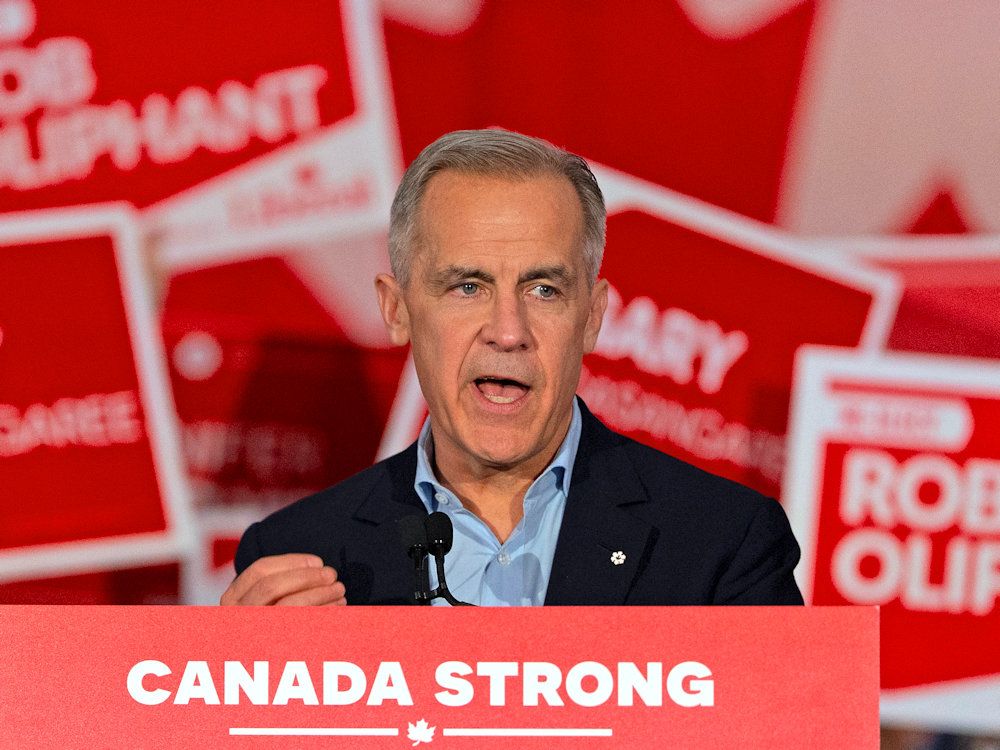
This isn’t a policy, but Carney has begun using lines in his speeches that are eerily similar to those being used by the Tories. Last week, the pro-Conservative group Canada Proud was circulating a video contrasting a Carney speech with a Poilievre speech that had been delivered only the day before. Here they are:
Poilievre: “What binds us together is the Canadian promise; that anyone, from anywhere, can achieve anything. That hard work gets you a great life in a beautiful, affordable home on a safe street protected by brave soldiers.”
Carney: “For generations, Canadians have built this great country on the idea that if you work hard … you should be able to afford a good life, have a good home in a welcoming and safe community.”
Housing affordability
Poilievre’s signature issue during his 2022 run for Conservative leadership was the notion of dispensing with the “gatekeepers” restricting housing development in Canada, and thus driving up the price of real estate.
This tracked pretty closely with a massive Liberal push on housing affordability, including the Housing Accelerator fund, a Liberal-devised program to incentivize municipalities to remove barriers to development.
Back in October, the Conservatives first wheeled out the idea of eliminating the GST on sales of new homes under $1 million.
On March 20, in one of his last acts before calling an election, Carney announced that his government was “eliminating the GST on all homes up to $1 million for first-time home buyers.”
Slogans
While politicians of all stripes often refer to Canada as the “best country” in the world, references to Canada as the “freest” country are quite rare. Prior to 2010, the term “freest country in the world” was only uttered in the House of Commons three times.
But Poilievre has adopted “freest country in the world” as a personal motto since 2012, and frequently ended speeches with it during his successful 2022 run for the Conservative Party. The phrase is so associated with Poilievre that rival Canadian politicians really only use it as a critique. Last September, for instance, Liberal House Leader Karina Gould said Poilievre “talks about making Canada the freest country in the world, but the only thing he has ever done is to take people’s freedoms away.”
On March 21, soon after his swearing-in as prime minister, Carney spoke of his desire to make Canada the “strongest, fairest and freest country in the world.”
LET’S POLL
Most polls have the Liberals somewhere between 44 and 46 per cent. But it’s a completely different story when it comes to the Conservatives. In 12 separate polls published over the course of the weekend, the Conservatives ranged from 34.9 per cent to 40 per cent.
Abacus Data remains an outlier in that it’s one of the few pollsters not to show a major Liberal lead. In fact, they think it’s a tie; surveys published on both April 3 and March 27 had both the Liberals and Conservatives with 39 per cent. As to why Abacus Data is so different, one factor might be that they’re weighting their results by voter turnout. Even if more habitual voters are planning to vote Liberal, Abacus’ data shows that the Conservatives are poised to disproportionately benefit from voters who would otherwise have stayed home.

GAFFETERIA
Last week saw Toronto-area Liberal candidate Paul Chiang quitting in the midst of controversy that he had joked about having his Conservative opponent — a wanted Chinese dissident — arrested by the Chinese government. And now the Liberals have picked Chiang’s replacement; Peter Yuen, also a former police officer.
Awkwardly, it didn’t take long for
in which Yuen, in full Toronto Police uniform, is seen singing the patriotic anthem My Chinese Heart. It was taken at a gala hosted by the Confederation of Toronto Chinese Canadian Organizations.
FOREIGN INTERFERENCE
Canadians used to be able to have federal elections without knowing which outcome was favoured by hostile foreign governments (answer: they usually didn’t care). In the 2021 election, it was eminently clear that the People’s Republic of China favoured a Liberal victory. And that seems to be how it’s shaping up this time. Canada’s new election integrity task force sounded the alarm Monday that a series of moderately pro-Carney posts were making their way around Chinese social media with the apparent help of the Beijing government.
Get all of these insights and more into your inbox by signing up for the First Reading newsletter here.

